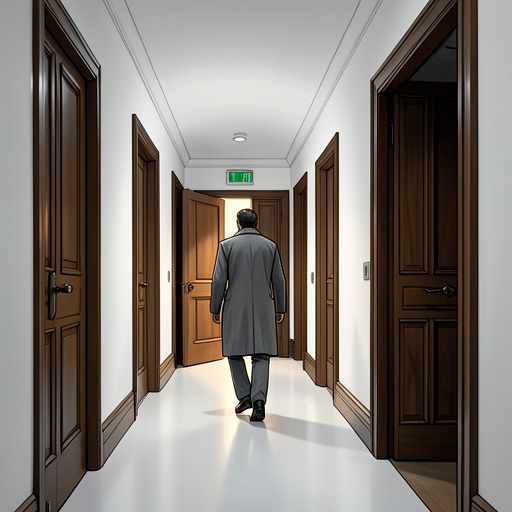
Ragen’s suicide attempt upon transfer to Ward 5
The Minds of Billy MilliganRagen’s suicide attempt upon transfer to Ward 5 is a crisis in which an apparent threat to hospital staff is later explained as an effort to take his own life. The distinction matters: the staff respond to what they can see, while the Teacher’s later account supplies an intention they did not understand in the moment. The episode turns on the gap between those readings, and on the consequences when a hospital security decision is experienced by Ragen as betrayal.
Background and escalation
The transfer came amid mounting strain between Billy Milligan and the staff treating him. After publicity about Billy’s case and his reaction to it, members of the Admissions and Intensive Treatment ward objected to the existing treatment arrangements and threatened to strike. Some believed Dr. David Caul was spending too much time with Billy and demanded that day-to-day management pass to the staff team. Dr. Caul reluctantly accepted a reduced role in order to keep Billy from being sent to Lima.
The revised arrangements included a written contract that sharply limited Billy’s privileges. It restricted access to sharp objects, phone calls, visitors, money, and unsupervised painting, and made restoration of privileges conditional on compliance. The contract was directed at Billy and the ward’s management of him; the account does not identify it as the direct cause of Ragen’s later action. It does, however, establish the restrictive institutional setting in which staff decisions, publicity, and the personalities’ sense of security had become tightly entangled.
The immediate crisis followed the therapy team’s decision to move Billy from his existing accommodation to Ward 5, the men’s locked ward. Billy did not understand why the transfer was happening and knew nothing about the alleged overdose or the ambulance trip with Mike Rupe. As unfamiliar male attendants began entering his room, Ragen took control. His response was not presented to the attendants as a disclosed plan for self-harm; they faced a sudden confrontation in the course of carrying out the transfer.
The Ward 5 confrontation
Ragen broke a drinking glass against the wall, held up a sharp piece, and warned the attendants not to approach. Norma Dishong called for help, and the hospital announced a Code Green. Dr. Caul came to the doorway and heard Ragen make a threat that sounded directed at him. When Caul asked why he was acting this way, Ragen accused the staff of betraying Billy and refused to go to Ward 5. Caul said the transfer was no longer his decision but a security matter, then left.
Several guards advanced behind a mattress, subdued Ragen, and restrained him on the bed. At that point Arthur stopped him from continuing to resist. A nurse prepared Thorazine, and Arthur objected, having heard Dr. Cornelia Wilbur say that antipsychotic medication could worsen splitting in people with multiple personalities. The medication was administered before his objection could prevent it. Arthur then tried to slow its effect, believing that doing so would keep the drug from reaching Billy’s brain. The scene moves quickly from a disputed transfer to physical restraint and medication, while the personalities’ different understandings of danger remain active inside the same crisis.
Staff carried Ragen out of the room and brought him to the second floor. Ward 5 presented a sharply different environment from a room where he had been able to remain with the existing treatment team: the narrative describes a small, bare locked room and other patients in acute distress. Arthur froze Ragen when he tried to break the door, and the focus shifted among the personalities as they reacted to confinement. Samuel prayed in distress; Philip cursed; David felt pain; Christene wept; Adalana noticed the tears; Christopher played with his shoes; Tommy examined the door; and Allen called for his lawyer. Other personalities expressed anger, fear, agitation, or withdrawal. Their varied reactions make the locked room not merely the destination of the transfer but the setting in which the consequences of the confrontation spread through the inner group.
The Teacher’s later explanation
The hospital response followed the visible actions: a raised piece of glass, a warning, resistance to attendants, and a refusal to enter the locked ward. The Teacher later offered a different account of what those signs meant. He said Ragen had not intended to hurt the guards. According to this explanation, the glass had been meant for Ragen himself, and the act was an attempt to end his life because he believed Billy had been betrayed.
The Teacher also clarified the threat that Dr. Caul had heard. He presented Ragen’s intended meaning as a demand that Caul watch him break bones, rather than a promise to break Caul’s bones. The clarification does not change what staff encountered or the danger they had to manage in the moment; it changes the reader’s understanding of the target of Ragen’s violence. In this retrospective account, what looked like an attack on others was a concealed self-directed crisis, expressed in language and action that invited a different interpretation.
The episode therefore depends on a consequential mismatch between outward conduct and inward intent. The staff treated the event as a security emergency and moved Billy to the locked ward. The Teacher’s account recasts Ragen’s behavior as despair and attempted self-harm, while making clear that the people responding to him lacked that explanation at the time. The narrative preserves both the institutional response and the later correction rather than collapsing them into a single perspective.
Aftermath and significance
The transfer did not settle the larger conflict over Billy’s treatment. Following Dr. Wilbur’s recommendation, the decision was made to keep Billy in Athens. Staff pressure had already forced a change in Dr. Caul’s authority and Billy’s daily conditions; the Ward 5 episode added a stark instance of how quickly a treatment disagreement could become a security matter. Later, after further events at the hospital, Billy was sent to Lima State Hospital for the Criminally Insane on October 4, 1979, in restraints and with time to say goodbye only to Dr. Caul. That later transfer was a separate event, not the immediate consequence of Ragen’s Ward 5 resistance, but it extends the book’s account of Billy’s movement between treatment and confinement.
In November 1980, Billy was moved again, this time to the Dayton Forensic Center, a maximum-security institution. Arthur and Ragen put Billy-U to sleep because they feared he might try to kill himself. During the subsequent period, Billy read, wrote, and sketched, but he was not allowed to paint. He hoped a 180-day hearing would lead to a return to Athens, where he believed Dr. Caul could treat him, fuse him again, and bring back the Teacher. These later developments do not resolve the earlier episode; they show how concerns about suicide and the conditions of confinement continued to shape the story.
The Ward 5 confrontation is significant because the Teacher’s explanation forces a distinction between a threat as heard and an intention not yet visible to others. Ragen’s accusation of betrayal, the staff’s security response, Arthur’s attempt to stop further resistance, and the later account of the glass’s intended use form competing but connected parts of the event. The episode makes the cost of that interpretive gap concrete: a crisis meant, in the Teacher’s account, to turn against Ragen himself resulted in restraint, medication, and transfer into a locked ward.